Sunday, 27 January 2013

Writing from the Back Burner

As writers, we are often plagued with writers block, other work, commitments or countless other reasons to *not* finish a writing project. Sometimes it simply doesn't take off the way you wanted it to, so you put the idea on the back burner and hope that you can get back to it some time. Some projects get left there, forgotten and cold. Others simmer... always there... bubbling... reminding you that they're still there.

For me, a Dracula TV series concept that I had wanted to develop had been stewing on that back burner since 1992. It was to be a modern-day sequel to Bram Stoker's famous vampire novel. I had written the pilot episode and three other scripts, storyboarded FX sequences (at a time when CGFX weren't available), wrote a series bible which included character backgrounds, backstories and a story arc for five seasons. To battle the 'campy' image that Dracula had acquired from Hollywood, I shot a promo video with Mickey Rooney narrating as Prof Van Helsing, setting up how Dracula survived, based on how Bram Stoker left a loop-hole in his ending. This video was effective in showing that Dracula was not going to be a cliché with a cape and a bad accent. It was perhaps too effective. In the age of political correctness it was deemed "too dark" for television. I was ahead of my time. The following year, 'The X-Files' premiered, followed shortly by 'Buffy the Vampire Slayer'. Alas, because of their successes, nobody wanted to compete with them, so my series was backburnered.

I then decided to work in the film industry to learn more about it, and got experience in several departments such as FX, props building, set dressing and art department. I also made my own films, one of which started as an episode from my Dracula series, which I shot as a digital experiment. It did well in film festivals all over the world.

But HE was always there. Taunting me. Trying to draw me back. I found myself involved in other Dracula projects, one of which was as 'historical researcher' for another novel sequel which turned Dracula into a romantic anti-hero. I had argued that the character choice was not true to Bram Stoker's Dracula but was shot down. "It's what the fanboys want," they said.

Well, they were wrong. The true Dracula fans had expected a cold, calculating, blood-thirsty monster and were disappointed with the love story this sequel told. I thought of my series again, and couldn't help but think how much those fans would have liked its references to the original novel.

For anyone who as never read Bram Stoker's Dracula, it is terrific. Told entirely through journal entries, letters, telegrams, newspaper clippings... its mystery unfolds slowly and deliberately. The readers know what the characters don't, and it isn't until they 'compare notes' that they realize what they are up against. For this reason, Hollywood has never been able to capture the true essence of the original novel: Most of it is internal, via private thoughts written in letters or diaries. I had come to realize how difficult it is to show internalization through a visual medium as I created my own films, and listened only vaguely to the bubbling from that back burner again.

Then one sleepless night while battling writer's block on another project, I was doing what a lot of writers do - wasting time on Facebook. While following the banter beneath a Friend's posting, I suddenly realized that I was seeing a new way to tell a story! Inspiration hit, and the lid on that old Dracula pot started to shake.

I went into storage, dug out my old series files and thanked myself for not ditching an old computer that can still read 3 1/4" floppy disks. After a full day of trying to remember what password I had used to protect them, I finally looked at the scripts that I had created 20 years ago. Then I took the opening scenes and 'revamped' them for a new medium and it worked!

Un-Dead disks (1992)


So, it begins anew. I will tell my sequel as if Bram Stoker had written it today: through e-mails, blogs, text messages, memos and social media. All of my previous experiences as a writer, director, props builder, film maker and graphic artist come together to launch 'Un-Dead' at last - as a continuous on-line novelization.

Click on undead-series.com to see the new site and follow along each week.

Un-Dead logo (word 'Un-Dead' hidden in bat)

Tuesday, 15 January 2013

Historical Research for the staging of The Diary of Anne Frank

As I was looking through my back-up files for old reference photos I found the folder containing stills from a stage production of The Diary of Anne Frank that I directed in 2004.

It's a clear example of my need for being historically accurate not only in my writing but in the shows I have worked on. During this production I not only had historical books and photos, but also a computer simulation of the Anne Frank House in Amsterdam. It allowed our actors to virtually 'walk' through the Secret Annex. I designed the set to be as close as possible to the real annex where Anne Frank and her family hid for two years.


Here are some of comparison photos of the Anne Frank House and our multi-level set.

Anne Frank's Room

Anne's real room (left) was duplicated in our set (right). For lighting reasons we didn't cover the windows with the tissue paper.

The pictures on the wall were duplicates of the pictures that are still currently hanging in her room. Even a similar desk lamp was found for our set.

The Main Room
On the left is the real common room for the eight people in hiding. On the right was our set. The door visible leads to Peter's room - which was also the access to the attic. Such was the case with our set as well.


The main room had been a laboratory, which is why the sink was so odd. It's a small attention to detail but a few audience patrons who had been to the real Anne Frank house did notice this.

Opekta was the brand of pectin that Otto Frank's company manufactured.  A year before going into hiding, Otto began stocking the attic with their belongings and supplies.
At the top of the show, the set had some replicas scattered around.


On the left is the real Water Closet (washroom) from the Anne Frank House.

The visible green door led to Anne's room. Likewise, our set had the W/C in the exact same layout.
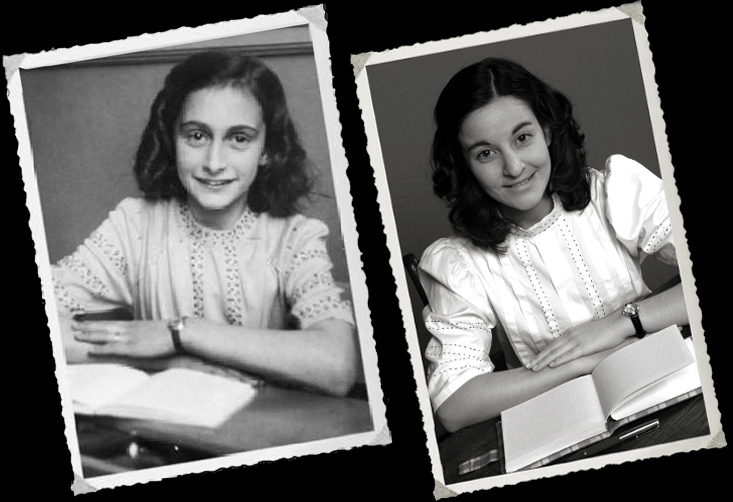
For a publicity still we recreated a famous photo of the real Anne Frank, taken before she went into hiding.


The talented actress (Jennifer Waiser) who portrayed our Anne Frank was dressed in a replica costume. Note the trim in the blouse and the wrist watch as well. 

There were other tiny historical details that I can't show here ie. recreating the exact chimes of the Westertoren bells which were melted down during World War II. Many such details were never really noticed, but it helped to authentically recreate a dark chapter of our human history. This stage production with an amazing cast of actors was seen by hundreds of school children, in hopes that they learn from history, never forget and never repeat it.


Review of The Diary of Anne Frank from TorontoStage .com 

Friday, 23 November 2012

Author's note for LUTETIA: Darkness Beneath the City of Light

In his youth, Victor Hugo was a devote Catholic and Royalist, loyal to the Monarchy and even wrote odes praising King Charles X and his family. Suddenly, in 1827, Victor Hugo changed drastically. He became a 'Free Thinker' and started writing plays and poems against the King and the Royal Family. There is no record as to what caused this turnaround in Victor Hugo. Even in his own memoirs, there is no mention of anything of importance in 1827, except for box office receipts from one of his plays.
 
But something did happen in 1827. Victor Hugo was inspired somehow to write an anonymous short story against capital punishment in 1828, and a stage play that caused a riot in the streets of Paris in 1830 - the same year he started writing 'Les Miserables' (which would take another 17 years to complete). What might have transpired that would alter his perspective so drastically?

“History has its truth, and so has legend. Legendary truth is of
another nature than historical truth. Legendary truth is invention
whose result is reality. Furthermore, history and legend have the same
goal; to depict eternal man beneath momentary man.”
             –Victor Hugo


Excerpt of first few chapters available on official website (with bonus materials): http://lutetia.weebly.com/


Saturday, 17 November 2012

Prologue - Lutetia: Darkness Beneath the City of Light

About half-way through writing 'Lutetia' for the NaNoWriMo contest, I was suddenly hit with the inspiration for a prologue that I didn't have before. So I'm including it here:
-

Prologue

Paris, 1885

The old man knew he had only a few breaths left in him. He was dying. It was only a matter of days before the curtain fell on the final act of his life. For one last encore, he wanted... nay, he needed to see her. If he didn't do this today it would never happen.

There it was again, that strange feeling that he was being watched. It was a sensation he had experienced many times in his long life. He used to think he was going crazy but experience taught him it was often true. Still in the doorway, the old man looked about the expansive warehouse at 25 rue de Chazelles. There were dozens of men working furiously on scaffolds and ladders, removing sections of copper, but none seemed to have taken notice of the old man being wheeled in.

"We shouldn't be here," said his nurse as she pushed his wheelchair over the threshold. He waved her away impatiently. If there was one thing he hated more than this wheelchair, it was having the bothersome nurse arguing with him all the time. She had had a screaming fit when she saw him getting ot of his 'death bed', though she was not likely concerned for his health, but merely hoping he'd just lie back down and die so she could be free of him.

The old man's thoughts were suddenly interrupted as he saw a familiar face. Sunlight streamed from the skylight above, illuminating her like an angel - no - a Roman goddess.

It looks just like her, the old man thought to himself. But how was that possible? It had been almost 40 years since he last saw her in person but her face was never far from his mind. She haunted his sleep and inspired his work during daylight hours. She was his muse.

He had to get out of this cursed wheelchair; it was not proper to meet a lady sitting down. He grasped the wooden armrests of the wheelchair with some difficulty, and pushed himself up.

"What are you doing?" scolded the nurse, trying to push him down again. "You can't do that!"

"Don't tell me what I can do or can't do, you crazy witch!"

"What is the meaning of this?" a young, male voice called out. "This is private property!"

"Forgive the intrusion," the nurse stammered as she let go of the old man, "but he insisted on coming here to see..."

The old man recognized Bartholdi's voice instantly but it was clear that the young, bearded man with long hair didn't recognize him. The old man wondered why. Had he aged so much since he and Bartholdi attended a fundraiser together? The old man's hair was shorter than it used to be, but his white beard was certainly longer.

"I'm sorry," Bartholdi argued, pointing to the large crates that surrounded them, "but we can't afford any interruptions of any kind. We are on a very tight schedule..."

"Monsieur Bartholdi," the old man said, struggling to make his voice loud enough to be heard, "I know I should have scheduled an appointment... but under my current circumstances I feared I would be negligent in keeping any future appointments."

Bartholdi's demeanor changed drastically the instant he recognized him, "Monsieur Hugo, I didn't know it was you! It is an honour to have you here... I thought you were..."

"Dead?" asked the old man. "Soon... very soon. So if you would indulge a dying man's request, I would like to see her before she leaves France forever."

"But of course," Bartholdi replied, then turned and whistled to all the workers. Everyone froze immediately and turned towards them. "Gentlemen, we have an important guest with us today. If it were not for him, She wouldn't be here today. Not only a respected writer but a great statesman. Champion of democracy and liberty. He himself inspired the name..."

"Thank you, sir," interrupted the old man, "but you did say you were on a tight schedule, and I don't want to take up too much time with unnecessary odes. Allow me a simple moment to bid her 'good-bye'."

"Of course," said Bartholdi with grace, as he stepped aside.

The nurse went to the back of the wheelchair but the old man waved her away, "Just give me my stick."

With a disapproving glare, she unfastened the walking stick from the wooden wheelchair's backrest, handed it to the old man and whispered, "Let me help you."

He shook his head. Then, using what little strength he had left, he supported his weight on his cane and walked toward her. He could practically feel the workers staring at him, but he didn't care.

The unblinking eyes of the statue greeted the old man as he neared her. He took a moment to catch his breath and stared at her calm, expressionless face. Yes, those eyes. They looked at him the same way she did. In all these years, he could never forget her eyes.

He glanced over to where her large fist clenched a torch with flames made of gold. How he wished he was a younger man and could accompany her to her new home in New York.

Reaching into his waistcoat's pocket, he pulled out a small silver coin. His trembling, wrinkled fingers held up the Denariu, a silver coin from Ancient Rome circa 42 BC. The coin that she gave to him all those years ago. The old man compared the Roman face on the coin to that of the statue in front of him. Their regal profiles showed a strength and femininity that were almost identical.

How many pieces of silver is your soul worth?

The words from his past echoed in his mind. He so wished he could take back those words. He had spent years trying to make up for the sins of his past. Not just his past but also that of his beloved country. He had endured hardships, exile and the loss that no father should experience. He never dared speak of events that took place in that cold winter of 1827, nor could he ever write it down for fear of the truth coming to light.

How many pieces of silver is your soul worth?

The old man wiped away a solitary tear, "I'm so sorry. I was such a fool. Before I die, I must know... Am I forgiven... Lutetia?"
 
 ---
Excerpt of first few chapters available on official website (with bonus materials): http://lutetia.weebly.com/


Bartholdi's Warehouse - Paris

Friday, 16 November 2012

New Award for My Novel!


Today I found out that my novel, Depth of Deception (A Titanic Murder Mystery)
was awarded "Finalist" in the "Best New E-book: Fiction" category.
 

The 2012 USA Best Book Awards
 

The novel is available on Kindle:
http://www.amazon.com/Deception-Titanic-Murder-Mystery-ebook/dp/B007O3IKTY

Also in various other formats (including print):
http://www.depthofdeception.com/

Wednesday, 14 November 2012

Research Map App

While researching for Lutetia: Darkness Beneath the City of Light, I wondered, 'Wouldn't it be great if you could do a side-by-side comparison of a Paris map from a few hundred years ago to today's map?'  Wait, there's an app for that, which I downloaded into my iPad.

Two things I noted while using this app.  Map making is certainly not the art form it used to be, look at that amazing detail (look at the Notre Dame Cathedral below). And secondly, the first manned hot-air balloon didn't happen until 51 years after this map was made - yet this map is surprisingly accurate in the layout of the Paris landscape and Seine River.


Paris 1734 Map App
 

NaNoWriMo update as of today (November 14, 2012) I'm just over 20,000 words.

-----
Excerpt of first few chapters available on official website (with bonus materials): http://lutetia.weebly.com/

Saturday, 10 November 2012

New Synopsis for LUTETIA

The year is 1827. Due to a case of mistaken identity, a young poet named Victor Hugo finds himself running for his life from the police, an assassin and a secret society. With the help of a mysterious gypsy girl, he uncovers a conspiracy that challenges his beliefs and loyalties.

Inspired by historical events that ultimately changed France forever and influenced Victor Hugo's literary works such as 'The Last Day of a Condemned Man', 'The Hunchback of Notre Dame' and 'Les Miserables'.

Lutetia Cover - Artwork by Victor Hugo
 
----
Excerpt of first few chapters available on official website (and revised book cover): http://lutetia.weebly.com/